Your organization must be able to handle and resolve IT issues on a day-to-day basis to sustain business. As such, your company needs IT Service Management (ITSM) to devise a strategic approach inclusive of designing, delivering, monitoring, and managing the way IT is used within an organization. ITSM operates with the goal of aligning your IT with your overall business objectives.
Modern ITSM practices have evolved from traditional IT and focus more on prevention rather than putting out fires after an issue escalates, as witnessed in break-fix ideologies of yester years. Management conversations have shifted from IT service catalogues to self-service models.
International Trading has been a trusted partner of ServiceNow ITSM, and also provides solutions that merge ITSM + ITOM to give you a seamless IT experience without the need for expensive infrastructure investment, ever. Here we list a few best practices for ITSM implementation, that we have gathered using our expertise on providing successful deliveries around the world.
A client is a piece of computer hardware or software that accesses a service made available by a server. The server is often on another computer system, in which case the client accesses the service by way of a network.
Organizations usually define "risks" and "costs" based on their client list or customer requirements, as end-users are often the ones paying for the services. While implementing ITSM, it is important for your organization to assign values and importance to your individual products and services relative to your customers within or attached to your company.
Whenever there is a mention of IT Service Management best practices, most people assume it is about the Information Technology Infrastructure Library (ITIL). While ITIL is probably the most widely-used iteration of ITSM best practices, it rarely is used in isolation. Most businesses use ITIL in tandem with other best practices methodologies like ISO 20000, TOGAF (The Open Group Architecture Framework), Application Service Library (ASL), Microsoft Operations Framework (MOF), CoBIT, and Six Sigma, depending on their needs. Customizing your implementation plan is a good idea.
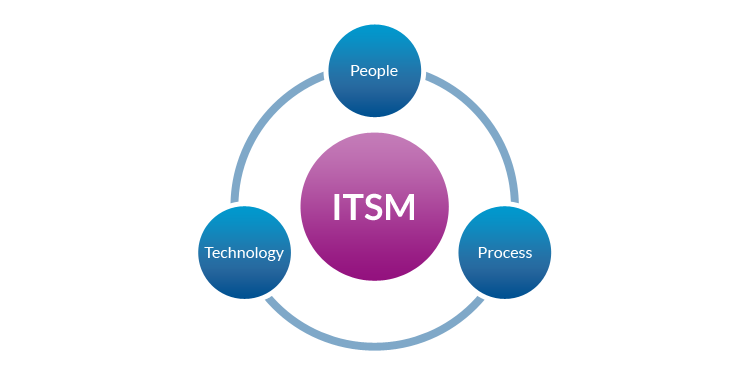
ITSM constitutes of the following key processes
IT Service Delivery
ITSM Implementation Framework
There is no such thing as the "perfect time" to implement ITSM—or a "perfect process." ITSM requirements vary from timeline to timeline, business to business, and user to user. Thus, there is no one-size-fits-all solution. If you’re worried about its negative impact on your ongoing processes, consider evaluating whether you have suffered a desired outcome hijack and lost a client due to a certain process being absent, poorly developed, or ignored.